
Showing posts with label pioggia. Show all posts
Showing posts with label pioggia. Show all posts
Wednesday, 3 January 2024

Thursday, 4 May 2017
flauta de lluvia
la flauta de lluvia es un nuevo instrumento musical tocado por la naturaleza misma.
se trata de una simple flauta de Pan con un agujero adecuado para que las gotas de la lluvia, al chocar con las flautas tapen el foro y generen un movimiento de aire dentro de las cañas y provoquen un sonido, una nota
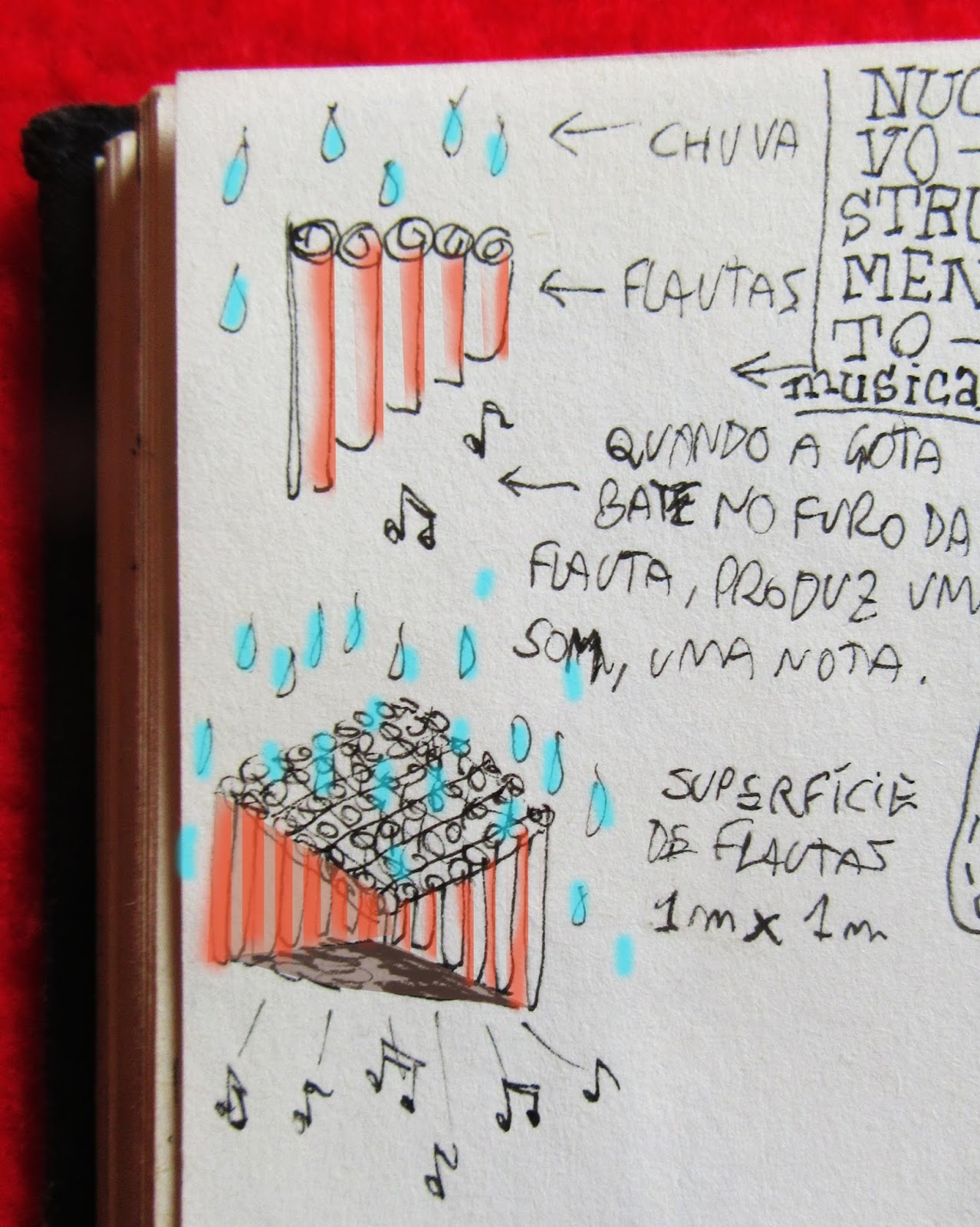
la cosa interesante de la flauta de lluvia es que no se trataría tan sólo de una linea de cañas, sino de toda una superficie, una extensión larga y ancha. esa superficie acabaría reaccionando melódicamente a casi todas las gotas de lluvia y generaría una sinfonía casual.
Sunday, 19 July 2015
cloud collector for the Sahara
when I started considering the idea of drawing the map of the geographical impact of a contrary spinning planet earth (if the earth span the opposite way) I focused my attention over the well known anomaly of the Himalayas mountains preventing India to became a complete desert as the Sahara and the Arabic which are on the same latitude.
starting from this deed I thought it was utopically possible to create an artificial barrier to stop clouds and humidity for desert regions as the western sahara coasts, for instance.
the big wall (5000m high!!) would be an horrifying destruction of all the ecosystem of northern Africa and a shocking environmental impact as well! besides it would be a very big danger for all the population and nature around in case of structural collapse of the building and, furthermore, it is technically impossible to build so far.
BUT these are not good reasons to stop imagining this awful solution as a functionally realizable system in order to achieve the task of a wetter Sahara coast-line!
can you imagine how horrible a huge 5 km tall wall crossing all western sahara regions north to south should be? a very huge disaster for the planet and a scaring structure to be seen from below...
anyway, the 5 km high wall would work as the Himalayas does for India, stopping the humidity coming from the Atlantic ocean and collecting the clouds in some season of the year provoking rain falls and the creation of huge rivers and so on.
this is a possible position of the wall even if I'm not sure if it's a good one!
maybe the eastern coast-line of the desert is a better place to catch the humid winds... (it depends of the air currents in that area) or possibly a east-west wall would work better than a north-south one.
anyway, that's not the point! just imagine! if it works naturally in Himalayas it can work artificially elsewhere!
so, this was the first idea:
stopping the clouds, provoking rain falls and also reducing the solar irradiation for the areas below the wall because the shadow of such a big barrier would stop the direct sun beams of a 40% (let's say).
as you can see the change for the region would be huge!
but even if this idea is just a utopic game for the imagination, the strong visual impact is too big to imagine even for me!! so I change my opinion about this crazy plan (even imagination has some ethical limits!).
Instead of a big wall, that's too much, maybe we could just use a system that already exists (in a very smaller scale) that is a fog-collector.
the humidity collector is a sort of simple net that literally catches the waters from the morning humid air and collect them into special reservoirs by mean of tubes .

so, what about building a structure (I mean, at least near the major cities and towns of the desert areas) that can do the same thing at a bigger scale?
we can imagine a 1000m high structure beyond the coasts of the cities of Western Sahara and Mauritania as a net filtering the clouds that generally pass above the dry country and that wind up evaporating by the heat.
the humidity of the clouds is now filtered and collected at a very big scale!
moreover the filter will block a bit the winds and the lower clouds as well, and it will also reduce the direct irradiation of the sun working as a solar screen for the town.

the impact would be less the before... and the advantages would be the same!
(I hope)
ok, but remember: this is just a utopia!
I really wouldn't like these kind of horrible structures would be built in reality!
please! just don't listen to what I said!!
starting from this deed I thought it was utopically possible to create an artificial barrier to stop clouds and humidity for desert regions as the western sahara coasts, for instance.
the big wall (5000m high!!) would be an horrifying destruction of all the ecosystem of northern Africa and a shocking environmental impact as well! besides it would be a very big danger for all the population and nature around in case of structural collapse of the building and, furthermore, it is technically impossible to build so far.
BUT these are not good reasons to stop imagining this awful solution as a functionally realizable system in order to achieve the task of a wetter Sahara coast-line!
can you imagine how horrible a huge 5 km tall wall crossing all western sahara regions north to south should be? a very huge disaster for the planet and a scaring structure to be seen from below...
anyway, the 5 km high wall would work as the Himalayas does for India, stopping the humidity coming from the Atlantic ocean and collecting the clouds in some season of the year provoking rain falls and the creation of huge rivers and so on.
this is a possible position of the wall even if I'm not sure if it's a good one!
maybe the eastern coast-line of the desert is a better place to catch the humid winds... (it depends of the air currents in that area) or possibly a east-west wall would work better than a north-south one.
anyway, that's not the point! just imagine! if it works naturally in Himalayas it can work artificially elsewhere!
 |
| possible position of the wall for the humidity recollection in western sahara. |
so, this was the first idea:
stopping the clouds, provoking rain falls and also reducing the solar irradiation for the areas below the wall because the shadow of such a big barrier would stop the direct sun beams of a 40% (let's say).
as you can see the change for the region would be huge!
but even if this idea is just a utopic game for the imagination, the strong visual impact is too big to imagine even for me!! so I change my opinion about this crazy plan (even imagination has some ethical limits!).
Instead of a big wall, that's too much, maybe we could just use a system that already exists (in a very smaller scale) that is a fog-collector.
the humidity collector is a sort of simple net that literally catches the waters from the morning humid air and collect them into special reservoirs by mean of tubes .

so, what about building a structure (I mean, at least near the major cities and towns of the desert areas) that can do the same thing at a bigger scale?
we can imagine a 1000m high structure beyond the coasts of the cities of Western Sahara and Mauritania as a net filtering the clouds that generally pass above the dry country and that wind up evaporating by the heat.
the humidity of the clouds is now filtered and collected at a very big scale!
moreover the filter will block a bit the winds and the lower clouds as well, and it will also reduce the direct irradiation of the sun working as a solar screen for the town.

the impact would be less the before... and the advantages would be the same!
(I hope)
ok, but remember: this is just a utopia!
I really wouldn't like these kind of horrible structures would be built in reality!
please! just don't listen to what I said!!
Tuesday, 2 July 2013
grondaie energetiche

ma siccome sappiamo che un flusso d'acqua puó sempre creare energia, perché non aprofittare di questo regalo del cielo e utilizzarlo per generare elettricità utilizzabile dagli abitanti dell'edificio?
l'idea è molto semplice: all'interno del rivestimento della parete ventilata di una palazzina qualsiasi collocare tutta una serie di grondaie che portano l'acqua dal tetto fino a terra. lungo il percorso dell'acqua piovana dall'ultimo piano fino al suolo, vengono collocate una marea di piccole dinamo che girano spinte dal flusso del liquido.

le linee di grondaia dovranno essere molte, il piú possibile. le dinamo anche dovranno essere collocate in modo fitto e costante. per favorire questo sistema di creazione di energia sarebbe piú vantaggioso disporre le grondaie con una inclinazione quasi orizzontale, in modo da allungare il tragitto da cui raccogliere energia e da smorzare la velocità del flusso d'acqua che alla lunga romperebbe le dinamo.
l'energia prodotta sarebbe poi immagazzinata in una batteria centrale che la redistribuisce anche dopo la pioggia. la produzione totale di corrente potrebbe essere limitata, forse, ma sarebbe pur sempre un risparmio. e poi in zone molto piovose o in territori tropicali con stagioni delle piogge e monsoni, oppure in zone nevose dove lentamente grandi quantità di neve si sciolgono, secondo me il risparmio sarebbe tutt'altro che ridotto.
pioggia = energia gratis.
p.s. Filippo Cavallari suggerisce l'utilizzo delle Pompe ad Ariete
Thursday, 27 May 2010
GOCCIA DOPO GOCCIA...

Senza la prima goccia che si secca sulla terra arsa
nessun diluvio può cominciare a scendere dal cielo
Wednesday, 17 March 2010
WEATHER FACES
 avete notato che facce fa la gente quando spioviggina o piove?
si ingobbisce, socchiude gli occhi, fa delle smorfie assurde, il collo sparisce tra le spalle...
invece quando esce il sole (specie se trasversalmente e dopo periodi di pioggia) avete notato come la gente sorride beata, quasi cammina ad occhi chiusi, facce di serenità pura!
non sarebbe bello fare un libro fotografico con le facce della gente in base al tempo che fa?
facce da pioggia
facce da sole
facce da vento
facce da freddo
facce da caldo
è una super idea, ne sono convinto, mi manca solo il fotografo che faccia delle bellissime foto! hahahahaha
Subscribe to:
Posts (Atom)